Research
A conceptual view of correlated quantum matter
Strongly correlated materials get their remarkable properties from the competition between a few basic factors: bandwidth, band filling, dimensionality, and the way charge, spin, orbital, and lattice behaviors interact. Small changes in this balance can cause the onset of unconventional superconductivity, charge and spin order, Mott insulating behavior, and other collective quantum phases.
Figure 1 offers a compact map of this landscape, highlighting the building blocks of correlated oxides and the ways their electronic states can be tuned.
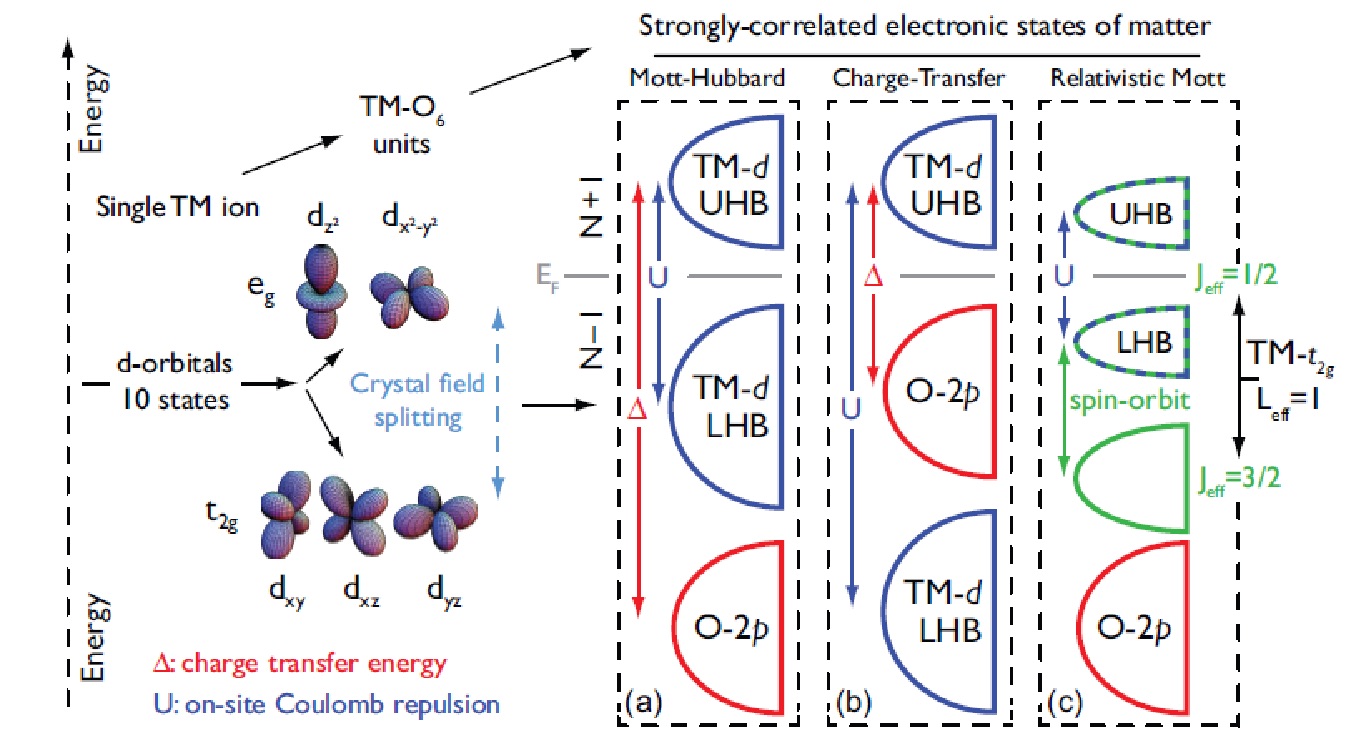
Figure 2 summarizes three classic electronic regimes that have shaped our understanding of transition-metal oxides: the Mott-Hubbard insulator, the charge-transfer insulator, and the relativistic Mott insulator.
Together, these provide a useful framework for thinking about how Coulomb repulsion, ligand hybridization, crystal-field splitting, and spin-orbit coupling work together to produce completely different quantum states. This is the broader perspective that drives much of our work across cuprates, ruthenates, iridates, and other quantum materials.