Multilayer nickelate superconductors
The recent discovery of superconductivity in multilayer nickelates has opened a new chapter in the search for cuprate-analog quantum materials. These compounds combine structural and electronic motifs reminiscent of the cuprates with a richer multiorbital character, raising fundamental questions about whether their superconductivity shares a common origin with high-TcT_cTc cuprates or instead emerges from a distinct microscopic mechanism. In particular, the bilayer and trilayer nickelates La3_33Ni2_22O7_77 and La4_44Ni3_33O10_{10}10 have rapidly become central to this effort following the observation of superconductivity under pressure and in strained thin films.
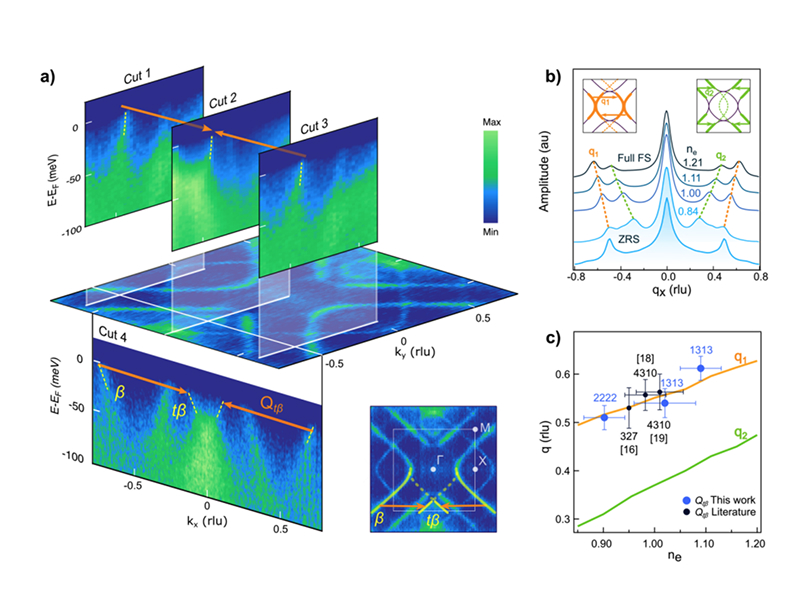
Our work uses ARPES to uncover the low-energy electronic structure of these materials and its connection to magnetism and superconductivity. By exploiting the unusual polymorphism of La3_33Ni2_22O7_77, we carried out a comparative study of the pure 2222 and 1313 stacking sequences and showed that, despite clear differences in their valence-band structure, they share a remarkably similar low-energy fermiology that is also common to trilayer La4_44Ni3_33O10_{10}10. We identified signatures of a doping-dependent spin-density-wave instability that reconstructs the Fermi surface, and used ARPES dichroism together with modeling to show that the relevant low-energy states are dominated by oxygen-centered planar orbitals whose symmetry evolves from 3-spin-polaron-like to Zhang-Rice-singlet-like character along the Fermi surface. These results establish an empirical link between multilayer nickelates and cuprates, and point to a common low-energy framework for unconventional superconductivity in the two families.
Publications