
Angle-resolved photoemission spectroscopy (ARPES)
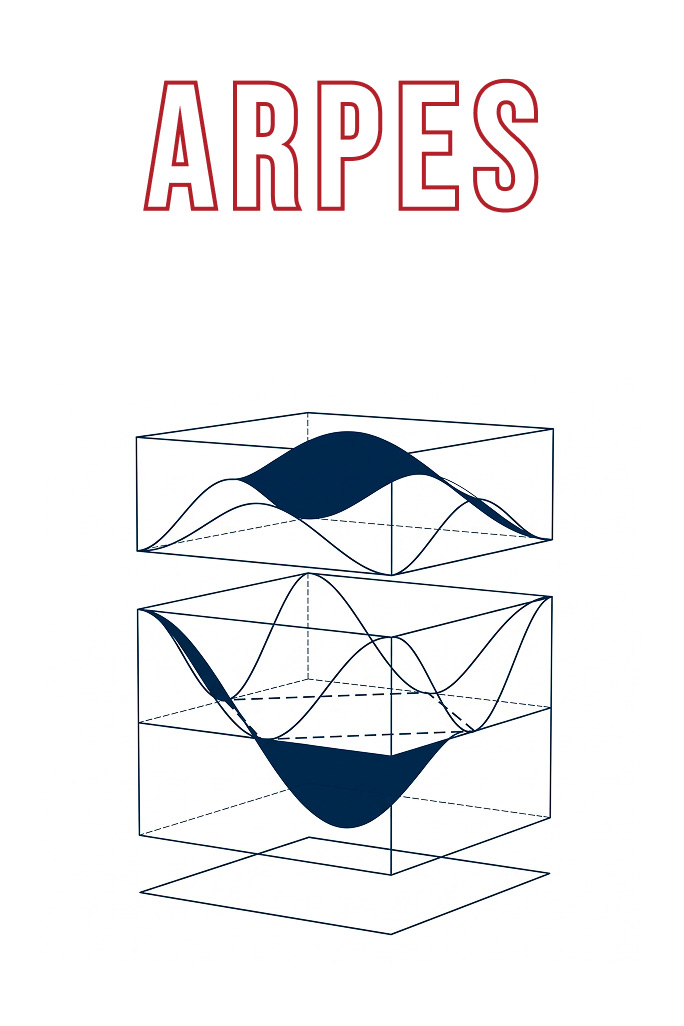
When light strikes a material, it can eject electrons from its surface. By measuring the energy and momentum of these photoemitted electrons, one can reconstruct a detailed picture of how electrons are arranged and propagate inside the solid. This is the essence of angle-resolved photoemission spectroscopy (ARPES), one of the most direct experimental probes of the electronic structure of quantum materials.
Beyond mapping band dispersions and Fermi surfaces, ARPES is uniquely sensitive to the fingerprints of many-body interactions: the measured spectral lineshapes, quasiparticle weights, and self-energy renormalizations encode the strength and character of electron-electron, electron-phonon, and other many-body effects. As a result, ARPES has become an indispensable tool for the study of correlated materials such as cuprate superconductors, transition-metal oxides, and topological systems.
Our group exploits the full power of ARPES, including polarization-dependent and laser-based measurements, to probe the interplay of charge, spin, orbital, and lattice degrees of freedom in quantum materials, providing direct experimental insight into the many-body physics that underlies their remarkable properties.